
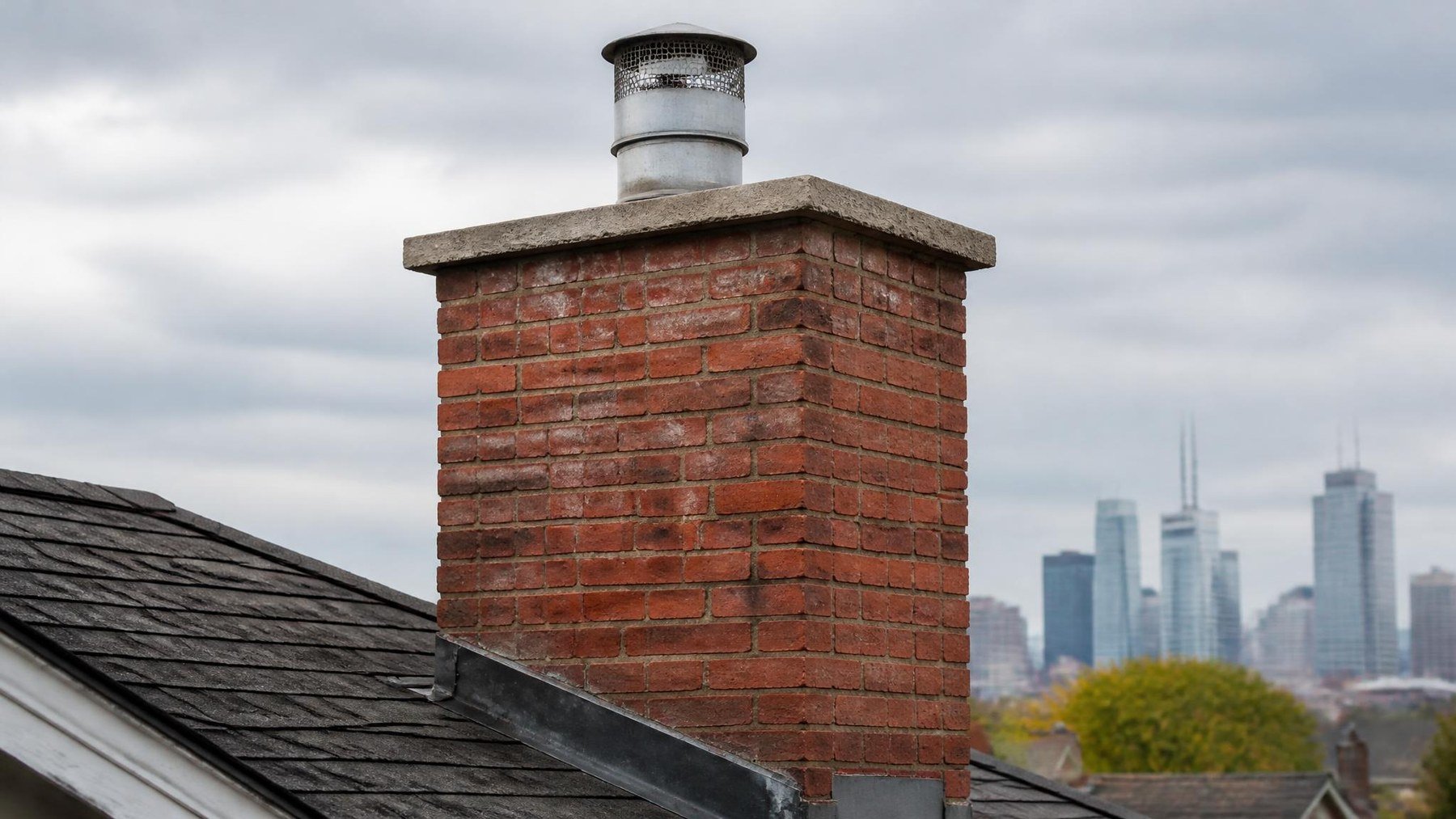
Chimney repointing is the right answer more often than people expect, and the wrong answer in a few specific cases. Repointing is appropriate when the bricks remain sound and stable and the main failure is deteriorated mortar, but damaged units, crown failure, leaks, or movement need a wider repair scope. Those exceptions are what separate a straightforward job from a rebuild.
A chimney is the most exposed masonry on a Toronto house. It stands clear of the roof on all four sides, it has no shelter above it, and it goes through the full freeze and thaw cycle while the rest of the wall is partly protected by the building itself.
We look at the units, the crown, the flashing and the plumb of the stack before we talk about joints, because joints are the easy part. Here is when mortar repair genuinely is enough.
When Repointing Is the Correct Scope
Four things have to be true, and they are easy to check from the ground with a decent zoom.
- The brick faces are intact, with no flaking, splitting or missing corners.
- The stack is plumb, with no lean and no bulge in any face.
- The crown on top is sound, or is being dealt with in the same project.
- There is no active leak showing up in the attic or at the ceiling below.
If all four hold and the mortar is simply receded, cracked or soft, then joint replacement restores the chimney. That is tuck pointing work done at height, and it is the most cost effective masonry repair there is.
What Good Joint Work Involves
Repointing is not surface filling. The failed mortar is cut back to sound material, the joints are cleaned, and new mortar is placed in a mix that suits the brick rather than the strongest one available.
That last point matters more on a chimney than anywhere else. Mortar is the sacrificial layer, meant to wear before the brick does. A mix harder than the units transfers both stress and moisture into the brick faces, and on the most exposed masonry on the house those faces have the least margin to spare.
The First Exception: Damaged Units
Spalling is the usual reason a chimney needs more than repointing. Where brick faces have flaked off, the unit behind is now absorbing water directly, and no joint around it changes that.
Those units get cut out and replaced, matched on size, texture, colour range and absorption. Where the loss runs through several courses the sensible scope is rebuilding the affected section down to sound work rather than replacing bricks one at a time. That is brick repair on top of the joint work.
The Second Exception: The Crown and the Cap
The crown is the sloped slab on top that sheds water away from the flue and beyond the brickwork. When it cracks, water enters the top of the stack and works downward through the masonry.
Repointing a chimney under a cracked crown means the new joints are being fed water from above.
The Third Exception: Leaks and Flashing
A stain on the ceiling near the chimney, damp in the attic around the stack, or a wet patch on the chimney breast is a leak that has to be located before any joint work.
The water may be coming through open joints, through a cracked crown, or past failed flashing where the chimney meets the roof. Those three repairs are carried out by different trades in different places. Repointing in response to a leak that is actually a flashing failure is the most common wasted chimney spend there is.
The Fourth Exception: Movement
A chimney that leans, has a visible bulge, shows a crack stepping through the brickwork, or has separated from the house wall has a structural problem. The joints are a symptom.
Stop, keep the area below clear if material is coming down, and get it assessed. Where reconstruction or structural work is involved the City publishes guidance on when a building permit is needed. Full rebuild scope is covered on our chimney repair and rebuilds page.
Repointing or Something Wider
| What you can see | Is repointing enough? |
|---|---|
| Receded or soft joints, brick faces intact | Yes, this is the straightforward case |
| Flaking or missing brick faces | No, those units need replacing first |
| Cracked or missing crown | No, the crown is dealt with in the same project |
| Ceiling or attic staining near the stack | No, locate the leak before pricing joints |
| Lean, bulge or stepped cracking | No, this needs assessment and likely rebuilding |
| Separation from the house wall | No, that is a structural question |
A Note on Season and Access
Mortar needs suitable temperature and protection to cure, so late season joint work on an exposed stack takes planning. Access is the other half of the cost, because safe working at that height is the same whether the job is four joints or forty. If the chimney needs units replaced and joints renewed, doing both in one setup is almost always the better value.
The Plain Answer on Chimney Mortar
Sound brick, plumb stack, decent crown and no leak means repointing is exactly the right job, and a good one will last. Spalled units, a cracked crown, an active leak or any lean means the mortar is not the problem and repointing alone buys very little. Check those four things before you accept a quote for joints only.
Show Brick Aid Masonry the damage
We are a family owned masonry company serving Toronto and the GTA. We assess the units, the crown and the stack before we quote the joints, give you an honest free quote, and back our work with a 2 year workmanship warranty. Request a free quote and send us photos of what you found.