
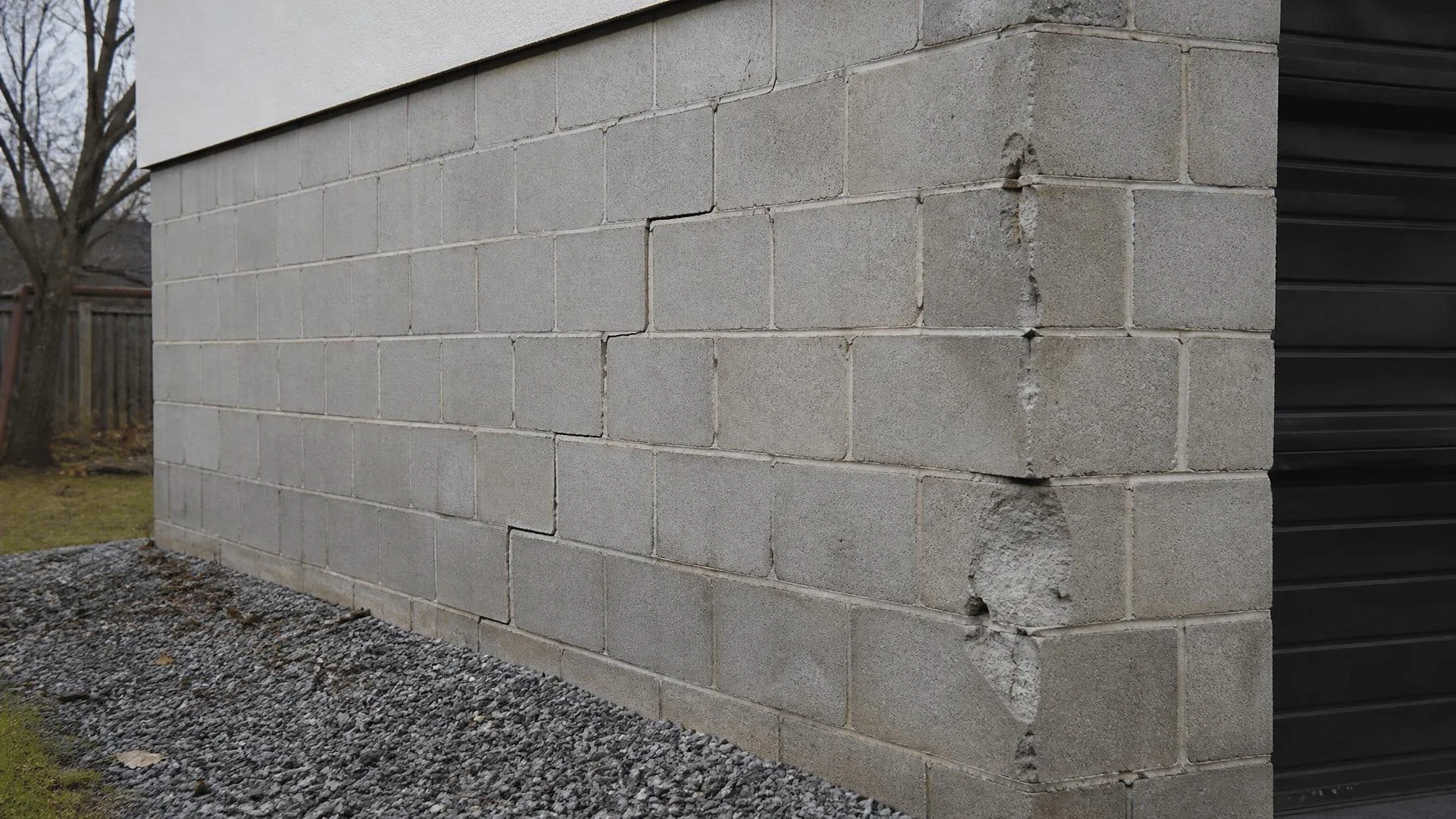
A bag of patching compound and an afternoon is the usual first attempt, and on the wrong crack it is money spent hiding evidence. Concrete block repair has to begin with the pattern. Small surface defects may be local, but stair step cracks, displacement, recurring moisture, or widening gaps point to a cause that patching alone will not correct.
Block walls are everywhere in the GTA: foundation walls under older houses, garage walls, commercial back walls, and the base of additions. They show their condition clearly if you know what to look at, and almost all of the serious cases announce themselves in the shape of the crack rather than its size.
We read the pattern first and we will tell you when a defect is genuinely cosmetic, because plenty of them are. Here is how to tell the difference between surface wear and a wall with a problem.
Crumbling Faces and Edges
This is the most common complaint and usually the least alarming, though it should not be ignored either.
What causes it
Block is porous. Water soaks in, freezes, and takes the surface off in flakes, and the process accelerates where salt is involved. On a garage wall or the exposed top of a foundation, the first course above grade takes splash, snow pile and road salt every winter, and that is exactly where the loss shows up.
What has to happen before resurfacing
Correcting the water source comes before any resurfacing. That means grade, downspout discharge, where the snow gets piled, and whether a hard surface is directing water at the wall. Then the surface can be made good with a material compatible with the block. Resurfacing a wall that is still being soaked simply relocates the problem behind the new coat. On a foundation wall this is often a parging conversation rather than a block replacement one.
Cracks That Follow the Mortar Joints
A crack that runs along the horizontal and vertical joints without passing through the blocks themselves is the mildest crack pattern on a block wall.
It often reflects shrinkage, minor seasonal movement, or old mortar that has simply reached the end of its life. If it is narrow, stable over a season, and shows no displacement in or out, joint replacement is the appropriate work. That means cutting out the failed mortar to sound material and refilling it properly, which is ordinary masonry repair.
How to know it is stable
- Mark both ends of the crack with tape and write the date on it.
- Photograph it beside a ruler or a coin for scale.
- Check it again after a freeze and after a thaw, roughly a season apart.
- Note any change in length, width or offset between the two sides.
- Check whether it is damp on either side after rain.
- Look at the matching spot inside, if there is one.
Cracks That Pass Through the Blocks
When a crack splits the block units rather than following the joints, something has overcome the strength of the unit itself. That is a different conversation.
Vertical cracks through units near a corner, a crack above or below an opening, or a crack that continues across several courses in a straight line all suggest a load or support issue. The crack is doing what the wall could not. Patching the line is cosmetic by definition here, because the force that opened it is still present.
Stair Step Cracking
This is the pattern worth learning. A crack that climbs the wall diagonally, stepping along one joint and up the next in a staircase, is the classic signature of differential settlement or movement in a block wall.
It means one part of the wall has moved relative to another. The cause sits below or beside the masonry: footing settlement, soil conditions, water undermining the base, or load changes. A structural engineer defines this, and the masonry scope follows that brief. Where foundation work, underpinning or structural repair is involved, the City publishes guidance on when a building permit is needed.
Bulging, Bowing and Displacement
On a foundation wall this is the finding that changes the urgency. A block wall that bows inward, shows a horizontal crack along one bed joint, or has courses offset from each other is being pushed, usually by soil and water pressure from outside.
A horizontal crack partway up a basement wall with the upper section leaning in is a recognised and serious pattern. It is not a patching job and it is not a parging job. Keep stored items away from the wall, stop adding load or water outside it, and get it assessed. Related foundation work sits with concrete and foundation repair.
Recurring Damp and Salt Deposits
Water showing up in the same place after every rain, white powdery deposits on the inside face, peeling paint and a musty basement are all one finding rather than several. Water is moving through the wall on a route that has not changed.
Sealing the inside face does not remove the water, it only moves where it appears. The useful sequence is to find the outside source, correct it, then deal with the wall. On commercial block walls the same logic applies and sits with commercial masonry planning.
Reading the Pattern at a Glance
| Pattern | Usual cause | Where it goes |
|---|---|---|
| Flaking faces, crumbling top edge | Water and salt saturation | Correct the water, then make the surface good |
| Narrow crack along the joints only | Shrinkage or aged mortar | Joint replacement once confirmed stable |
| Crack splitting through the blocks | Load or support problem | Engineer defines it before masonry scope |
| Diagonal stair step crack | Differential settlement or movement | Engineer, with cause addressed first |
| Horizontal crack with the wall leaning in | Lateral soil and water pressure | Assessment promptly, no patching |
| Damp and salts returning in one spot | An unchanged water route | Find and correct the outside source |
What Patching Can and Cannot Do
Patching is a legitimate finishing step once the cause is handled. It restores a surface, tidies an edge, and keeps water off a face that has lost its skin. What it cannot do is resist movement, carry load, stop water that is still arriving, or close a crack that is still opening. Every one of those failures looks fine for a season, which is exactly why patching the wrong crack is such a common mistake.
The Honest Read on a Cracked Block Wall
Look at the shape before the size. Flaking and crumbling is usually water and salt, so fix the water. A narrow crack along the joints that holds still for a season is joint work. A crack through the units, a diagonal staircase, a bow or an offset means the wall is being moved by something, and that something gets identified before anyone mixes mortar. Damp in the same spot every spring is a drainage project wearing a masonry costume.
Show Brick Aid Masonry the damage
We are a family owned masonry company serving Toronto and the GTA. We assess block, brick, foundations and drainage in person, give you an honest free quote, and back our work with a 2 year workmanship warranty. Request a free quote and send us photos of what you found.