
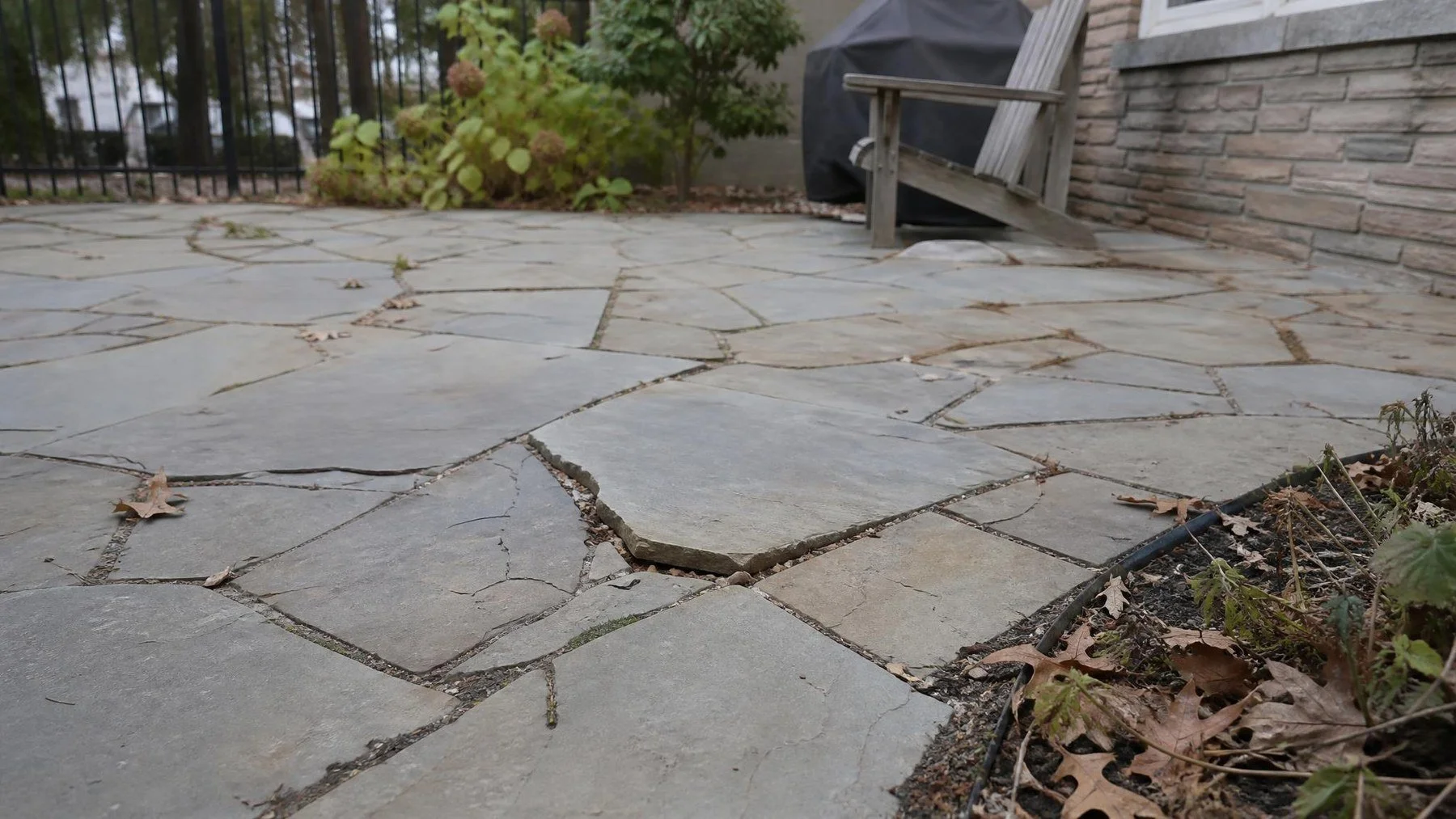
One stone rocks underfoot on the front walk and the joints around it have turned to grit. Flagstone repair starts by sorting which of those two things is the actual problem. Reset sound stones when the base or level has failed, renew joints when the stones remain stable, and replace only units that are cracked or too deteriorated to reuse.
Flagstone in Toronto and the GTA takes a specific beating. Water sits on a flat surface, soaks the bedding, freezes, and lifts. Salt in winter does the rest. A walk or patio that looked perfect in its first five years can start rocking in its tenth with nothing wrong with the stone at all.
We lift a stone and look at the bed before quoting, because what is underneath decides everything above it. Work through the questions below and you will know which of the three jobs you actually have.
Question One: Does the Stone Rock When You Step on It?
Stand on each corner of the suspect stone and feel for movement. This single test separates most of the work.
If it rocks but the stone is whole
The bed under it has washed out, settled, or was never compacted properly. The stone is fine. It gets lifted, the bed is rebuilt and compacted to the right level, and the stone goes back down. That is a reset, and it is the most common flagstone repair there is.
If several stones move together
Now the question moves below the bedding into the base and the drainage. A group of stones moving as a set, a dip that holds water after rain, or a low area beside a downspout means the sub base is the problem. Resetting the stones individually will not hold.
Question Two: Are the Joints Gone While the Stones Stay Put?
Look along the joints. Sand or mortar missing, weeds coming through, and gaps you can get a finger into, while every stone stays solid underfoot.
This is the straightforward case. The joints get cleaned out and renewed, with the material chosen to suit how the walk was built in the first place. A mortared flagstone surface and a sand set one are not interchangeable, and filling one with the other's material is a common and expensive error. Stone work generally is covered on our stonework page.
Why the joint material has to match the build
- A mortared surface on a rigid base needs a joint that can be cut out and replaced later.
- A sand set surface needs a joint that lets water through rather than trapping it.
- Putting rigid mortar into a flexible surface cracks it out again within a season or two.
- Sealing a mortared joint with the wrong product traps water under the stone.
- Weeds are a symptom of an open joint, not a reason to use a harder material.
Question Three: Where Does the Water Go?
This is the question that decides whether the repair lasts. Flagstone fails where water collects, and water collects where the fall is wrong or the drainage stopped working.
Walk the surface after rain, or wet it down and watch. Look for standing water, for fall running back toward the house rather than away, for a downspout discharging straight onto the stone, and for a lawn or bed that has grown up above the surface and now holds water against the edge. Fix the fall and the discharge or the same stones will lift next spring.
Question Four: Is the Stone Itself Finished?
Only now does replacement come into it. A slab is genuinely done when it is cracked right through, when it has split into layers, when the surface has flaked away to a thin remnant, or when a corner has broken off beyond piecing in.
Weathering, colour change and surface patina are not reasons to replace.
If you do need new stone
Match thickness as well as type and colour, because a slab of a different thickness has to be bedded differently and tends to settle differently. Keep any sound stones you lift, since a matching replacement for an older walk is often easier found in your own pile than in a yard.
The Four Answers in One Place
| What you found | The job | What goes wrong if you skip the cause |
|---|---|---|
| One stone rocks, stone intact | Lift and reset on a rebuilt bed | Mortar packed around it cracks out again |
| Several stones move as a set | Base and drainage repair, then reset | Individual resets settle again by spring |
| Joints open, stones stable | Clean out and renew the joints | Wrong joint material cracks or traps water |
| Standing water or wrong fall | Correct levels and discharge first | Every repair above it repeats the failure |
| Slab cracked through or delaminating | Replace that unit, matched on thickness | A patched slab breaks along the same line |
| Surface weathered but sound | Leave it alone | Money spent on appearance, not condition |
What to Check Before You Call
- Step on every stone and mark the ones that move.
- Photograph the whole surface, then each defect, with the date.
- Wet the surface and photograph where water stands.
- Note where downspouts and surface runoff reach the stone.
- Lift one loose stone if you can do it safely and photograph the bed underneath.
- Count how many stones are cracked through rather than simply worn.
That record turns a vague quote into a defined one. Steps, landings and raised areas bring their own questions, and where the work involves a structure or a retaining element the City publishes guidance on when a building permit is needed. Full service detail is on our flagstone page, and isolated work sits with general masonry repair.
The Plain Verdict on a Rocking Walk
Most flagstone that looks finished is not. Rocking stones get lifted and reset. Open joints get renewed in the right material for how the surface was built. Water gets sent somewhere else before anything is bedded back down. Replacement is for slabs that are cracked through or coming apart in layers, and that is usually a handful of stones rather than a whole walk.
Show Brick Aid Masonry the damage
We are a family owned masonry company serving Toronto and the GTA. We look at the bed and the drainage before we quote the stone, give you an honest free quote, and back our work with a 2 year workmanship warranty. Request a free quote and send us photos of what you found.