
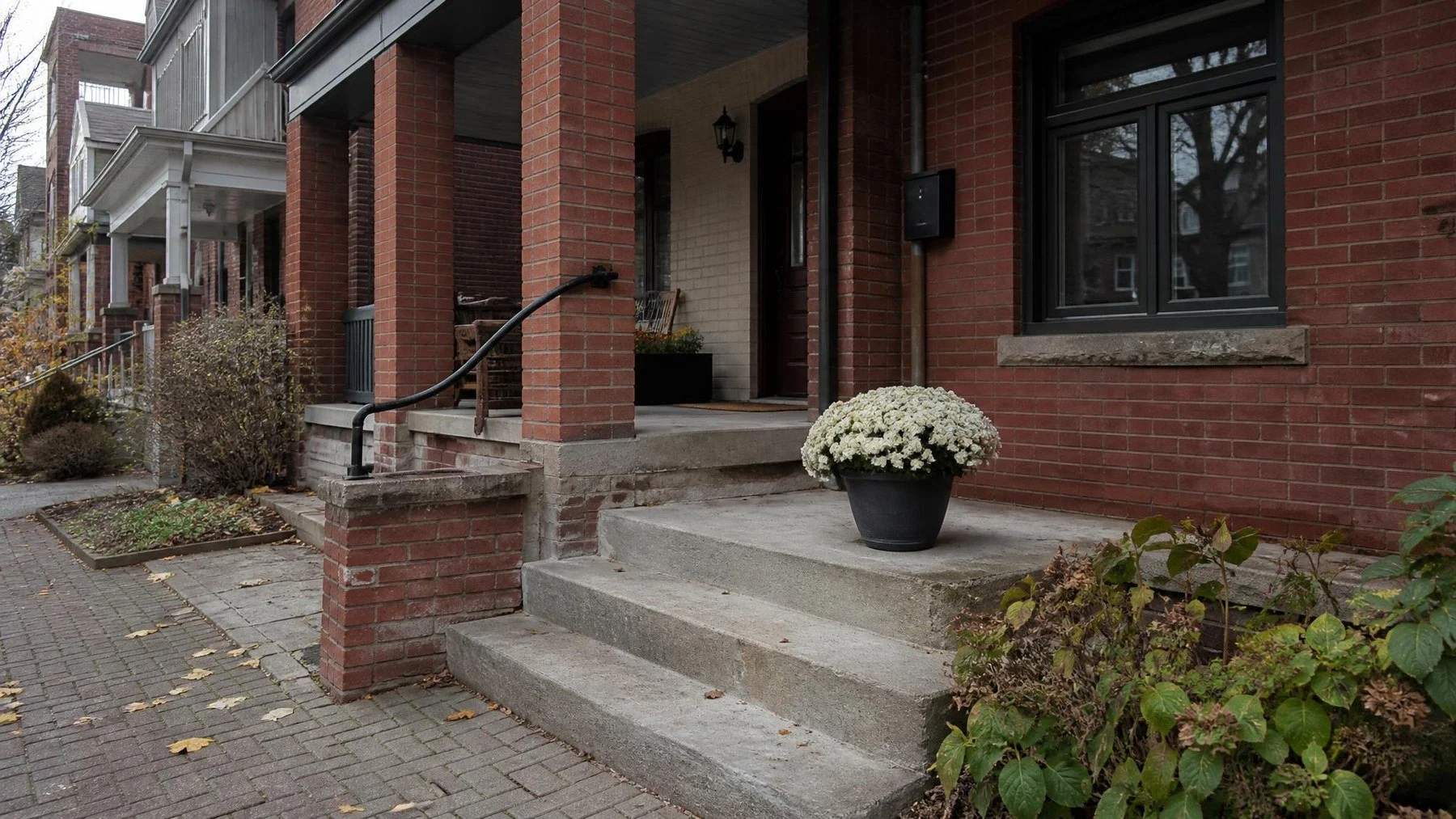
Every October a Toronto homeowner looks at a hundred year old front porch and asks whether it can be patched or whether the whole thing has to come down. Brick porch repair sits on a scale, and the damage decides where. Surface mortar loss may need repointing, isolated failed units may need replacement, and widespread movement or support failure needs a broader rebuild assessment.
Porches are the hardest worked masonry on a house. They sit at ground level where snow, salt and splash collect, they take the full freeze and thaw cycle on exposed horizontal surfaces, and they often sit on a foundation that was never as substantial as the one under the house.
We would rather reset and repoint a porch that only needs it than sell a rebuild, and we will say so when the damage is cosmetic. The hard part is telling the three cases apart, so here is how.
Case One: Repointing, When Only the Joints Have Gone
This is the best case and the most common on a porch that has simply never been maintained.
What qualifies
Mortar receded, cracked or washed out, with the brick faces intact and every unit firmly in place. Sand gathering on the treads. Joints you can rake out with a key. No displacement, no rocking, no bulging in the piers or sidewalls, and nothing out of level that was once level.
What the work covers
Joints cut back to sound mortar and refilled with a mix suited to the brick rather than the strongest available, then tooled to a profile that sheds water. On a porch the detail that matters most is the joint at every horizontal surface, because that is where standing water gets in.
Case Two: Patching and Replacement, When Units Have Failed
Here individual bricks have lost their faces, split, or crumbled, while the structure is still sound and square.
Why patching the face is usually the wrong answer
A mortar patch smeared over a spalled brick face is the cheapest thing a contractor can do and the first thing to fail. It has no bond to speak of, it sits proud of the surface, it holds water against the unit, and it falls off in one piece after a winter. A failed unit gets cut out and replaced, not coated.
What a good replacement involves
- Cutting out the failed unit without damaging its neighbours.
- Matching the replacement on size, texture, colour range and absorption together.
- Bedding it on a mix compatible with the surrounding joints.
- Accepting that a new unit in an old wall will not match perfectly on day one.
- Finding out why that unit failed, because its neighbours share the condition.
Colour matching on a century porch is genuinely difficult, and an honest contractor will show you a sample before committing. This is the core of brick repair.
Case Three: Rebuild Assessment, When Something Has Moved
This is the case that cannot be priced from a photograph, because the question is what the porch is standing on.
The signs that put you here
- The porch slab or steps have dropped, tilted, or pulled away from the house wall.
- A pier or sidewall is leaning, bulging, or out of plumb.
- Stepped cracking through the brickwork rather than along the joints.
- Treads rocking as a set, not one loose unit.
- A gap at the house wall that has visibly widened.
- Any part of the structure that moves when weight is put on it.
Why it is an assessment and not a quote
Movement comes from the base, the fill, drainage, a failed footing, or in older porches a timber or steel element inside that has rotted or corroded. Rebuilding the visible masonry over an unresolved base repeats the failure. Where the structure or its support is involved, permit questions arise, and the City publishes guidance on when a building permit is needed. Base and footing work sits alongside concrete and foundation repair.
Putting the Three Cases Side by Side
| What you see | Where it lands | What has to be true |
|---|---|---|
| Open or soft joints, units sound and tight | Repointing | Nothing moving and nothing out of level |
| A few spalled or split bricks in a sound porch | Unit replacement | The cause of that failure is understood |
| One rocking tread over firm support | Reset that unit | The bed has failed, not the base |
| Steps or slab dropped or pulled from the house | Rebuild assessment | Base and drainage examined first |
| Pier or sidewall leaning or bulging | Rebuild assessment | Support condition defined before scope |
| Stepped cracks through the units | Rebuild assessment | Movement cause established |
How to Keep Quotes Comparable
- Photograph the porch from the street, then each defect close, all dated.
- Put a level on the treads and the landing and photograph the result.
- Note whether cracks follow joints or cut through bricks.
- Ask every contractor to price the same defined scope, not their own version of it.
- Ask what happens to the base and the drainage in each proposal.
- Ask explicitly what is excluded, and get that in writing.
Three quotes for three different scopes tell you nothing. The same scope priced three ways tells you everything. Isolated local work falls under general masonry repair.
The Verdict on an Old Front Porch
Joints alone means repointing. Failed units in a sound structure means cutting them out and replacing them properly, never smearing mortar over the damage. Anything that has dropped, leaned or pulled away means the base gets looked at before a price is written. Most century porches in this city need the first two. The ones that need the third usually show it in a level, not in a photograph.
Show Brick Aid Masonry the damage
We are a family owned masonry company serving Toronto and the GTA. We assess porches, steps, brick and foundations in person, give you an honest free quote, and back our work with a 2 year workmanship warranty. Request a free quote and send us photos of what you found.