
Stone Wall Repair: What Loose or Cracked Stone Is Telling You
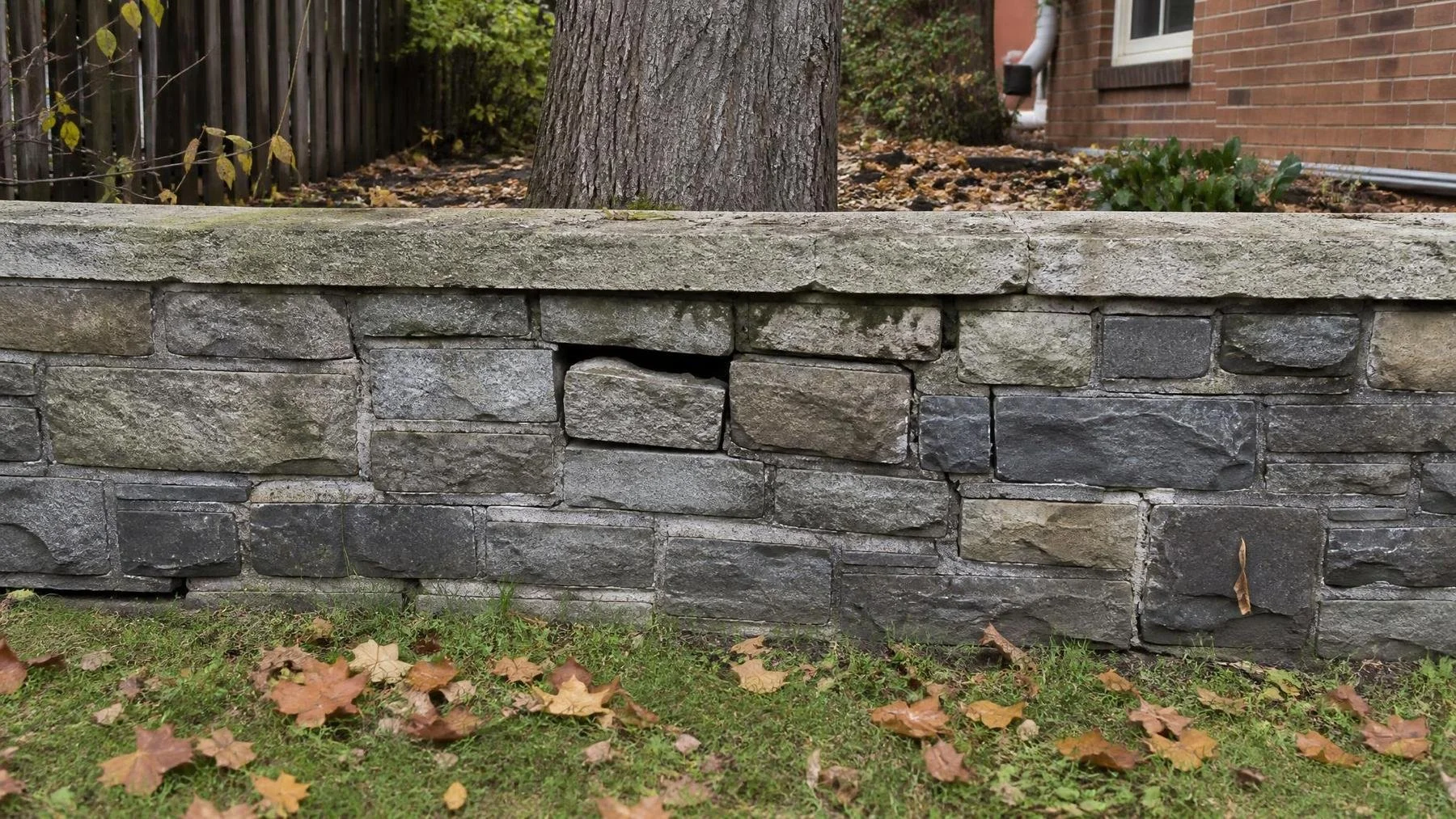
The costly mistake in stone wall repair is mortar in a gap. Loose or cracked stone can come from failed joints, trapped water, movement, or corroding embedded metal, so the cause must be identified before resetting or patching the surface. Fill the gap without answering that question and the same stone is loose again within a season or two, usually with a wider crack beside it.
Stone is patient. A wall can take years of water finding the same route before anything shows, which is why the first visible symptom is almost never the first thing that went wrong. Across the GTA that water arrives through a wet autumn and then freezes, and freeze and thaw works like water prying a crack wider each cycle.
We read a stone wall from the ground up and from the water down before we price anything, because the repair for a failed joint and the repair for a moving wall share nothing but the trowel. Here is what each symptom usually means.
Cause One: The Joints Have Simply Worn Out
This is the ordinary case and the best outcome. Mortar is the sacrificial layer, meant to wear before the stone does, and on an older wall it eventually does exactly that.
What it looks like
Mortar sitting well back from the face, soft enough to rake out, sand collecting at the base of the wall, and stones that are stable but no longer tight. The stones themselves are sound, with no cracking through the units and no displacement.
What the joint work has to restore
Joint replacement at a proper depth, with a mix suited to the stone rather than the strongest available. A mortar harder than the surrounding stone transfers stress and moisture into the unit, and the unit is the part that cannot be remade. This is routine stonework maintenance.
Cause Two: Water Is Getting In and Staying In
Trapped water is the engine behind most stone failure in this climate. The question is never whether water reaches the wall, it is whether the wall can let it go again.
Where it comes from
- A cap, coping or top course with open joints or no wash to shed water.
- Downspouts and surface runoff discharging at or into the wall.
- Grade, paving or planting beds holding water against the base.
- A previous repair in a dense mortar or a coating that sealed the face.
- Saturated soil behind a wall that is retaining anything at all.
What it looks like on the face
Persistent damp patches, salt deposits, moss and algae on one zone only, surface flaking on the stone, and joint failure concentrated under a specific detail above. Fix the source before the symptom or the repair is temporary by design.
Cause Three: Something Is Moving
This is the category that changes who writes the scope. Movement means load and support, and no amount of joint work addresses it.
The signs worth taking seriously
- A bulge or belly in a run of wall that was once straight.
- A lean, measured against a vertical reference rather than by eye.
- A crack that is wider at one end, or that steps diagonally through the courses.
- Displaced stones at a corner, or a corner opening up.
- A crack that has visibly changed since it was first marked and dated.
A structural engineer defines the problem here, and the masonry scope follows from that. Where the wall is retaining soil, height and surcharge also raise permit questions, and the City publishes guidance on when a building permit is needed. Retained walls are dealt with on our retaining walls page.
Cause Four: Corroding Metal Inside the Wall
Older stone walls contain more metal than people expect. Cramps, dowels, anchors, lintels and railing fixings were all set into stone as a matter of course.
Steel expands as it corrodes, and it does so with enough force to split the stone around it. The telltale pattern is a crack or a spall radiating from one point, often with rust staining nearby, in an otherwise sound area. Patching the face over corroding metal hides the cause and the stone breaks again from inside.
Matching the Symptom to the Work
| What you are looking at | Most likely cause | What the work involves |
|---|---|---|
| Stable stones, soft or receded joints | Joints worn out | Joint replacement with a matched mix |
| One rocking stone, sound neighbours | Lost bedding under that unit | Reset the stone on a sound bed |
| Damp, salts, flaking in one zone | Trapped water from above or behind | Correct the source, then repair the face |
| Bulge, lean or stepped crack | Movement or loss of support | Engineer first, then defined rebuilding |
| Crack radiating from a point, rust nearby | Corroding embedded metal | Expose, treat or replace the metal, then repair |
| Cracked through the stone itself | Stress, impact or frost in a flaw | Replace or piece in the unit, matched |
What You Can Safely Check Yourself
- Photograph the whole wall, then each defect, and keep the date on the file.
- Mark each crack at both ends with tape and the date, then check it in a month.
- Note whether cracks follow the joints or pass through the stones.
- Look for rust staining, salt deposits and damp zones, and where they sit relative to what is above.
- Check the top of the wall and the ground at its base for where water arrives and leaves.
- Stay off a wall that is bulging or leaning, and keep traffic away from it.
Record it and bring the record to the conversation. Isolated unit and joint work falls under general masonry repair.
What Loose Stone Actually Means
A loose stone is a question, not a diagnosis. Work out whether the joint wore out, whether water is sitting in the wall, whether something is moving, or whether metal inside is splitting the unit. The first two are masonry work. The third belongs to an engineer before it belongs to a mason. The fourth has to be opened up and dealt with properly, because a patch over rust is a repair with a countdown on it.
Show Brick Aid Masonry the damage
We are a family owned masonry company serving Toronto and the GTA. We assess stone, brick, joints and foundations in person, give you an honest free quote, and back our work with a 2 year workmanship warranty. Request a free quote and send us photos of what you found.