
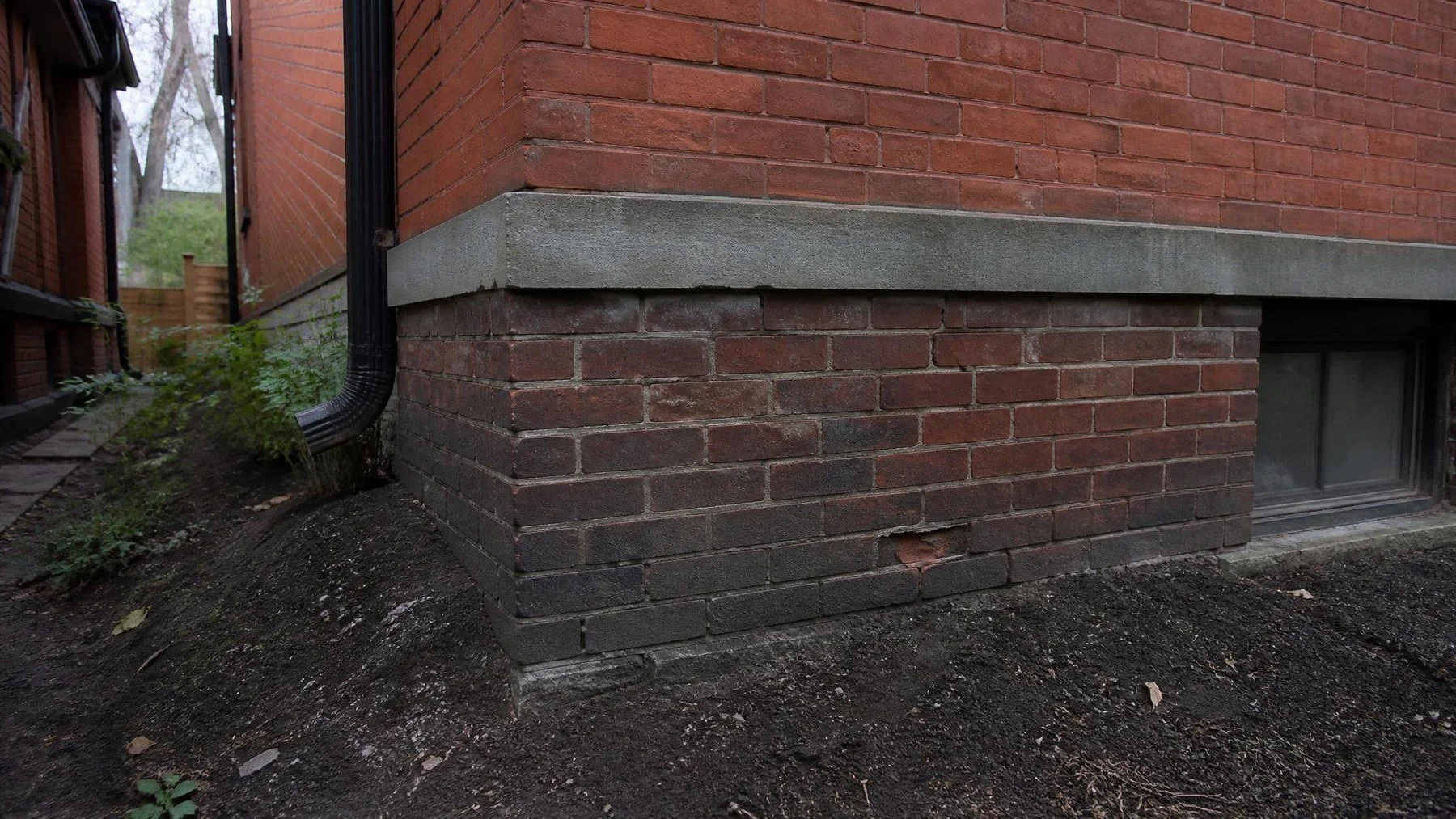
Exposed brick foundation wall showing mortar deterioration below the exterior brickwork
Brick foundation repair starts with one question: has the mortar failed, have the bricks failed, or is the wall moving? Each problem needs a different response. Filling every crack with the same product can hide the evidence without fixing the cause.
Brick Aid Masonry repairs deteriorated foundation walls across Toronto and the GTA. This guide shows you where repointing or brick replacement fits, when drainage work must come first, and when a mason should bring in a structural professional.
Start by separating surface failure from wall movement
Stand back before you inspect the wall up close. Look for a pattern across the full height and length of the foundation. Check the moisture source and surrounding masonry before deciding that soft mortar near grade needs only repointing. A long horizontal crack, visible bow, offset bricks, or repeated stair step cracking needs assessment before you select a repair.
The existing guide to foundation crack warning signs explains how crack direction, width and change over time affect urgency. For this repair decision, identify whether the damage is in the mortar, the bricks or the wall’s support.
| What you see | Likely first scope | What must be checked |
|---|---|---|
| Mortar is powdery, recessed or missing while bricks remain sound | Selective repointing | Mortar compatibility, joint depth and moisture source |
| Several bricks have lost faces or broken apart near grade | Brick replacement plus joint repair | Drainage, salt exposure and whether damage continues behind the surface |
| A short wall section has loose or displaced units | Assessment of stability, then local rebuilding if suitable | Support above, wall bond, cause of displacement and need for structural review |
| The wall bows, shifts or keeps reopening after repair | Structural review before masonry work | Soil pressure, footing movement and temporary support |
Match the repair to the part that failed
Repoint sound brick with compatible mortar
Repointing removes deteriorated mortar and packs the joint with a compatible replacement. The National Park Service guidance on repointing advises choosing mortar for the building, exposure and masonry condition instead of treating every wall alike. Its preservation scientist Catherine Cooper puts the principle plainly: “In historic buildings, the mortar is sacrificial.”
That matters on older Toronto brick. Mortar that is harder and less permeable than the surrounding unit can push moisture and stress into the brick. A proper tuck pointing and repointing scope identifies the existing material, removes only failed joints and matches strength, colour and profile.
Replace units that have lost their face or core
Repointing cannot restore a brick that has split, crushed or lost too much of its face. Those units need careful removal and replacement. The new brick must suit the wall in size, absorption and appearance, while the new joints must work with both the replacement and the original masonry.
Isolated damage often stays within a focused brick repair. A wider band of deterioration at grade may need several courses rebuilt. The quote should state which units come out, how the wall will be supported and how the new work will tie back into sound masonry.
Rebuild only the section that cannot be retained
A local rebuild makes sense when bricks have shifted, the bond has opened, or previous patching has left a weak pocket. The mason dismantles to stable work and rebuilds the section in sequence. That is different from taking down an entire foundation wall.
Ask the contractor to mark the proposed repair boundary on a photo. A marked boundary helps you compare quotes. Ask how hidden damage would change the scope and price.
Stop the water before you close the wall
Foundation masonry lives beside wet soil, snow and roof runoff. Repairing joints while water continues to collect against the wall shortens the useful life of the work. The Government of Canada recommends grading soil and hard surfaces away from the home so water drains away from the foundation.
Check downspout discharge, low spots, cracked paving, failed window wells and areas where soil touches brick above the intended grade line. Then decide whether the masonry repair and drainage correction belong in the same project or in a set order.
A parge coat is not structural repair. Parging can renew a sound foundation surface, but it should not cover loose brick, failed joints or active wall movement.
Know when masonry work is not enough
A mason can repair mortar, brick, block and limited wall sections. Movement below the wall changes the project. New bowing, offset masonry, ongoing settlement, or work that alters the footing calls for a structural assessment before anyone removes material.
Ontario warns about underpinning hazards when project specific engineering and sequencing are missing. The City of Toronto requires a building permit for residential underpinning and identifies cases that need a professional engineer. If the repair reaches the footing, changes support, or requires excavation beside another building, confirm the permit and design path before accepting a quote.
That pause protects the home and gives the mason a defined repair boundary. Brick Aid can complete the masonry repair portion once the structural scope is clear.
Ask for a repair scope you can verify
A useful quote should name the affected wall area, removal depth, number or location of replacement units, mortar approach, water correction, access needs and cleanup. It should also separate confirmed work from allowances that depend on what demolition reveals.
- Ask what evidence shows the wall is stable enough for masonry repair.
- Ask which bricks and joints will be removed and which will stay.
- Ask how the mortar will be matched to the existing wall.
- Ask what must happen to drainage before the repair is closed.
- Ask whether the scope needs a permit or engineering review.
The repair should address both the damaged masonry and the cause of deterioration.
Get the repair boundary right first
Brick Aid Masonry can inspect the wall, separate masonry damage from wider movement and quote the repair that fits. Review the foundation repair service or request a free on site assessment across Toronto and the GTA.