
Flagstone Walkway or Patio? How to Choose and What It Costs
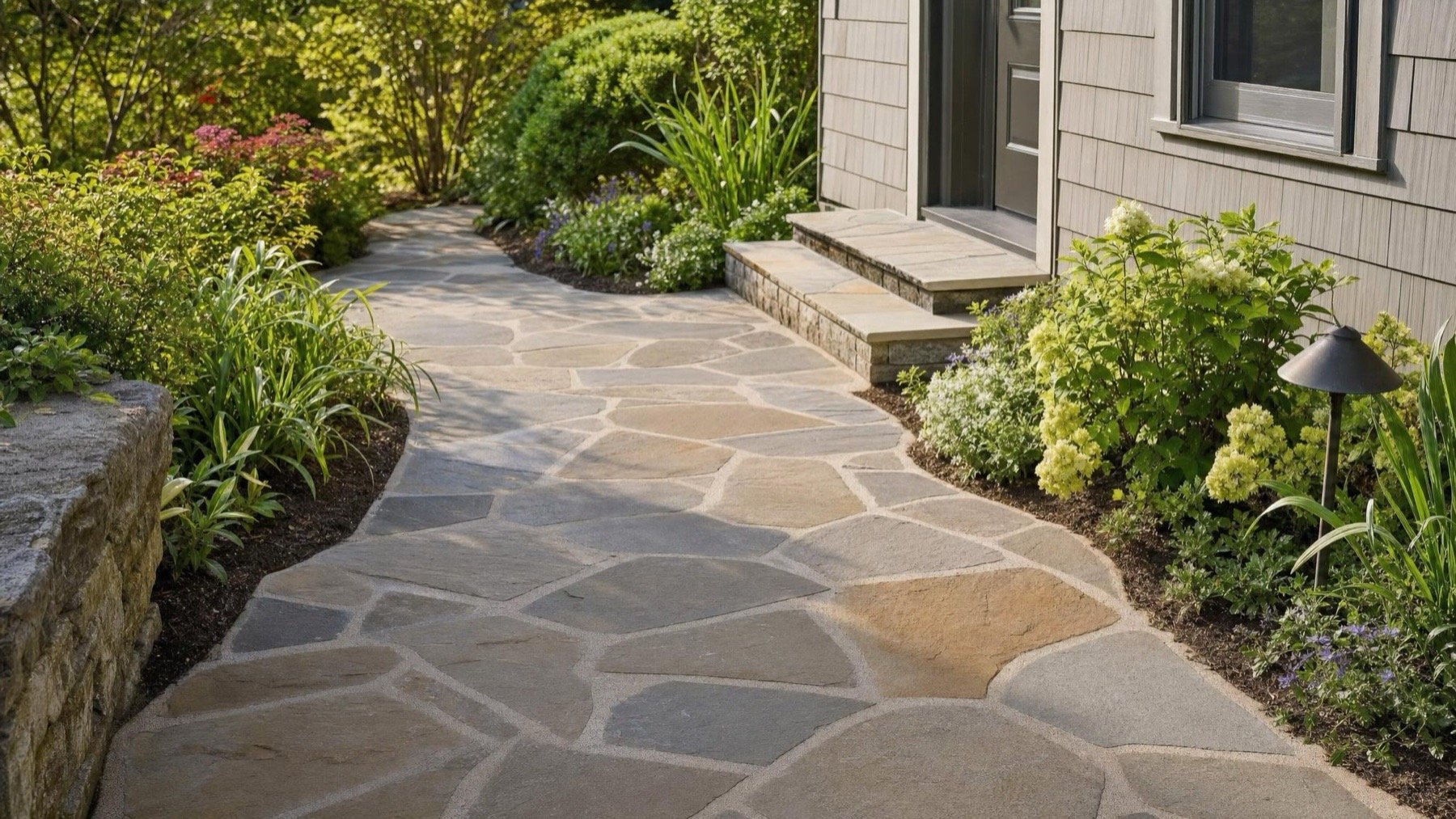
Flagstone gets chosen for how it looks and then judged on how it survives eight winters.
The stone itself is rarely what decides that. The base, the drainage and the joints do, and those are the parts you cannot see once the job is finished.
Start with how the surface will be used
A walkway and a patio carry different loads and different expectations. A path takes concentrated foot traffic in a narrow line and needs to stay level enough not to trip anyone. A patio carries furniture, needs a flatter surface for chairs, and gets used barefoot.
What that changes
- Path: thicker irregular stone tolerates a dry laid base and slight movement
- Patio: flatter, more uniform stone and a stiffer base to stop chair rock
- Driveway edge or vehicle load: neither, without an engineered base
- Poolside: texture and slip resistance outrank appearance
Know what the base decides
Two approaches dominate. Dry laid sets the stone on compacted granular with sand or stone dust joints. Mortar set bonds the stone to a concrete slab.
Dry laid moves with frost and can be lifted and relevelled. Mortar set is rigid, holds a flatter surface, and cracks if the slab beneath it moves. In a climate with dozens of freeze and thaw cycles a season, that difference is the whole decision.
Where mortar set goes wrong. Bonding stone to a slab that was not built for frost gives you two problems instead of one. If the slab lifts, the stone and the joints crack with it, and the repair means breaking out both.
Compare the flagstone options
| Dry laid | Mortar set on slab | |
|---|---|---|
| Frost movement | Absorbs and can be relevelled | Cracks if the slab moves |
| Surface flatness | Slight variation | Flat, better for furniture |
| Repairability | Lift and reset individual stones | Break out and rebuild the area |
| Weed and ant pressure | Joints need maintenance | Sealed joints, less intrusion |
| Best suited to | Paths, informal patios, slopes | Formal patios, steps, landings |
Stone choice sits underneath that. Irregular natural cleft looks traditional and hides small level differences. Sawn or square cut gives tight joints and a formal line but shows every variation in the base.
Check drainage and frost before anything is laid
Water under flagstone is what lifts it. The base has to drain and the surface has to shed.
The things worth confirming in a quote
- Excavation depth and the granular thickness being installed
- Compaction in layers rather than one deep lift
- A fall away from the house of roughly two percent
- Where surface water goes once it leaves the paving
On sloped sites this often ties into retaining work, which is covered on our retaining walls page.
Plan the joints and the edges
Edges hold the whole assembly together on a dry laid surface. Without a restraint the perimeter stones migrate outward, the joints open, and the field follows within a few seasons.
Joint filling is the maintenance item. Polymeric sand locks tighter and resists weeds but needs correct installation and will fail if the joints are too wide or the surface stays wet. Stone dust is more forgiving and needs topping up.
Full installation and repair detail is on our flagstone installation and repair page, and larger stone work sits under stonework.
Before choosing a stone from one sample, view several pieces dry and outdoors. Natural flagstone varies across a pallet, and that variation belongs in the finished surface. Decide where cut edges can hide. Careful layout keeps narrow fragments away from entrances and other places that take concentrated foot traffic. It also lets the installer place flatter stones where chairs or gates need stable clearance. Plan that layout before excavation begins.
Frequently asked questions
Is flagstone a good choice for Toronto winters?
Yes, provided the base drains and the installation allows for movement. Dense stone handles freeze and thaw well. Most failures trace to an under built base or trapped water rather than the stone.
Should flagstone be dry laid or set in mortar?
Dry laid suits paths, sloped ground and anywhere frost movement is likely, and individual stones can be reset. Mortar set suits formal patios, steps and landings where a flat surface matters, but it needs a slab built to resist frost.
How thick should flagstone be for a walkway?
For dry laid pedestrian use, thicker irregular stone is more forgiving because it resists rocking and cracking when the base settles slightly. Thin stone belongs on a bonded slab, not on granular.
Why is my flagstone lifting and rocking?
Almost always the base. Insufficient depth, poor compaction, or water collecting underneath and freezing. Resetting the stones without correcting the base returns the same result within a season or two.
Do flagstone joints need sealing?
The joints need filling and maintaining rather than sealing as a rule. Polymeric sand resists weeds and washout when installed correctly. Surface sealers change appearance and can trap moisture, so they are a preference rather than a requirement.
Build it so the base outlasts the stone
Brick Aid Masonry builds flagstone walkways and patios on bases sized for Toronto frost, with proper edge restraint and drainage. Free on site assessments across Toronto and the GTA with a 2 year workmanship warranty. Call (647) 271-2697 or book a free assessment.