
Rusting Lintel Above Your Window? How to Tell What It Needs
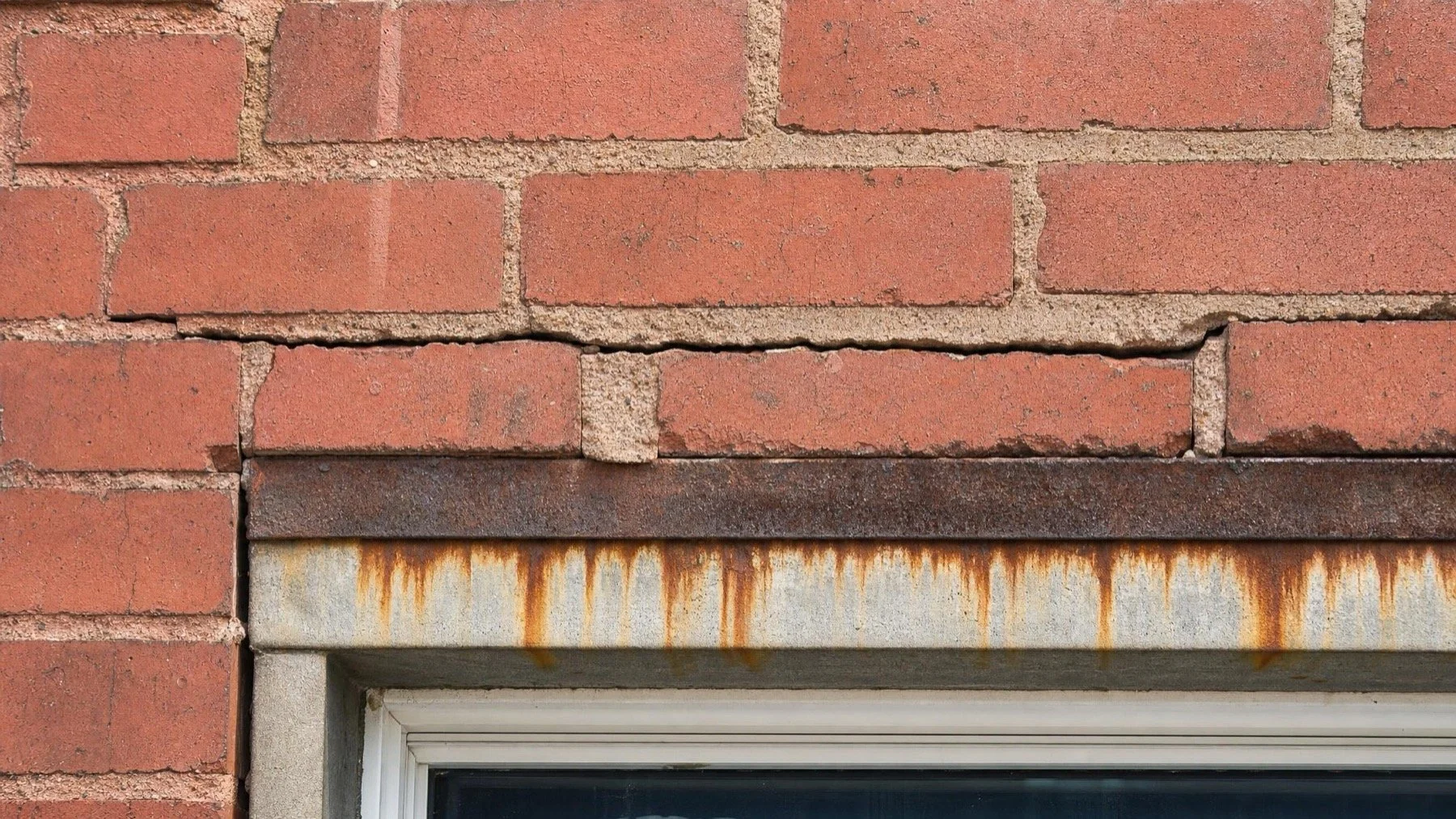
A horizontal crack running along the joint directly above a window is rarely a mortar problem.
In most Toronto homes there is a steel angle carrying the brick over that opening, and when it corrodes it grows. That growth is what cracked the joint.
Find the lintel before you judge the crack
The lintel sits in the wall directly above the opening, usually a painted steel angle with one leg under the brick and one leg back into the wall. On many houses you can see its lower edge as a thin dark line above the window frame.
Signs it is the lintel and not the mortar
- The crack is horizontal and sits in the first or second joint above the opening
- Rust staining runs down the brick below the crack
- The joint is wider at the middle of the opening than at the ends
- The same pattern repeats over several windows on the same elevation
Mortar failure looks different. It appears across the wall rather than concentrating above openings, and our guide to the signs your joints need repointing covers that pattern.
Know what rust jacking does
Steel corrodes into iron oxide, and iron oxide occupies several times the volume of the steel it replaced. Trapped between masonry, that expansion has nowhere to go but outward.
The result is predictable. The joint above the lintel opens first, then the brick directly on the steel begins to crack or displace, and eventually the outer leg of the angle bows away from the wall. Each stage costs more to correct than the one before.
Why painting it does not work. Paint on the visible face leaves the corroding surfaces sealed inside the wall untouched. It changes the colour of the problem and nothing else.
Compare the repair options
| Stage | What is happening | Typical scope |
|---|---|---|
| Early | Surface rust, joint hairline | Clean back, treat, repoint the joint |
| Moderate | Joint open, staining, no brick damage | Remove brick course, strip and coat steel, rebed |
| Advanced | Brick cracked or displaced | Support the opening, replace the lintel, rebuild the course |
| Severe | Angle bowed, brick loose above | Engineered support and full opening rebuild |
The jump in cost between moderate and advanced is the reason to act on staining rather than waiting for movement. Once the brick above has to come down and go back up, the job has changed category.
Check the brick above and beside the opening
The lintel is rarely the only thing to inspect. Water reached that steel from somewhere, and the same path is loading the rest of the wall.
Where the water usually comes from
- A failed or missing sill above, letting water into the wall head
- Open joints in the courses above the opening
- Caulk failure at the window frame
- Blocked or absent drainage behind the veneer
Replacing the steel without correcting the water source starts the same clock again on a new lintel.
Plan the work in the right order
The sequence is fixed. Support the load above the opening, remove the brick course, expose and assess the steel, replace or treat it, restore drainage, then rebuild the masonry with matched brick and compatible mortar.
Skipping the support step is how a window opening becomes a wall rebuild. Any quote that does not describe how the load is carried while the course is out is not a quote for this job. Details of how openings are handled properly are on our window and door openings page, and general remedial work sits under masonry repair.
Ask whether the quote includes matching brick, compatible mortar and correction of the water entry point. Treating the steel while leaving a failed sill or open joint above it restarts the corrosion cycle inside a rebuilt course and wastes the access the repair created.
Frequently asked questions
Is a rusted lintel dangerous?
Not immediately in most cases, but it is progressive. Corrosion expansion keeps lifting the masonry until brick cracks or displaces above the opening. Early stage staining is cheap to correct and advanced displacement is not.
Can a rusted lintel be repaired without removing the brick?
Only at the earliest stage, where corrosion is on the exposed face and the joint has barely opened. Once rust has formed between the steel and the masonry, the course above has to come out to reach it.
Why is there a crack above only some of my windows?
Exposure. The elevations that take the most driving rain corrode first, and openings under a failed sill or a leaking gutter run ahead of the rest. Different windows on one house often sit at different stages.
Do all brick houses have steel lintels?
No. Older solid masonry buildings often use brick arches or stone heads instead. Homes built through the mid twentieth century onward commonly use steel angles, which is where rust jacking shows up.
Will repointing fix the crack above my window?
Not on its own. Repointing closes the visible joint while the steel behind it keeps expanding, so the crack returns. The joint is the symptom and the lintel is the cause.
Get the lintel assessed before the brick moves
Brick Aid Masonry inspects the steel, identifies where the water is entering, and scopes the repair to the stage the lintel is actually at. Free on site assessments across Toronto and the GTA with a 2 year workmanship warranty. Call (647) 271-2697 or book a free assessment.