
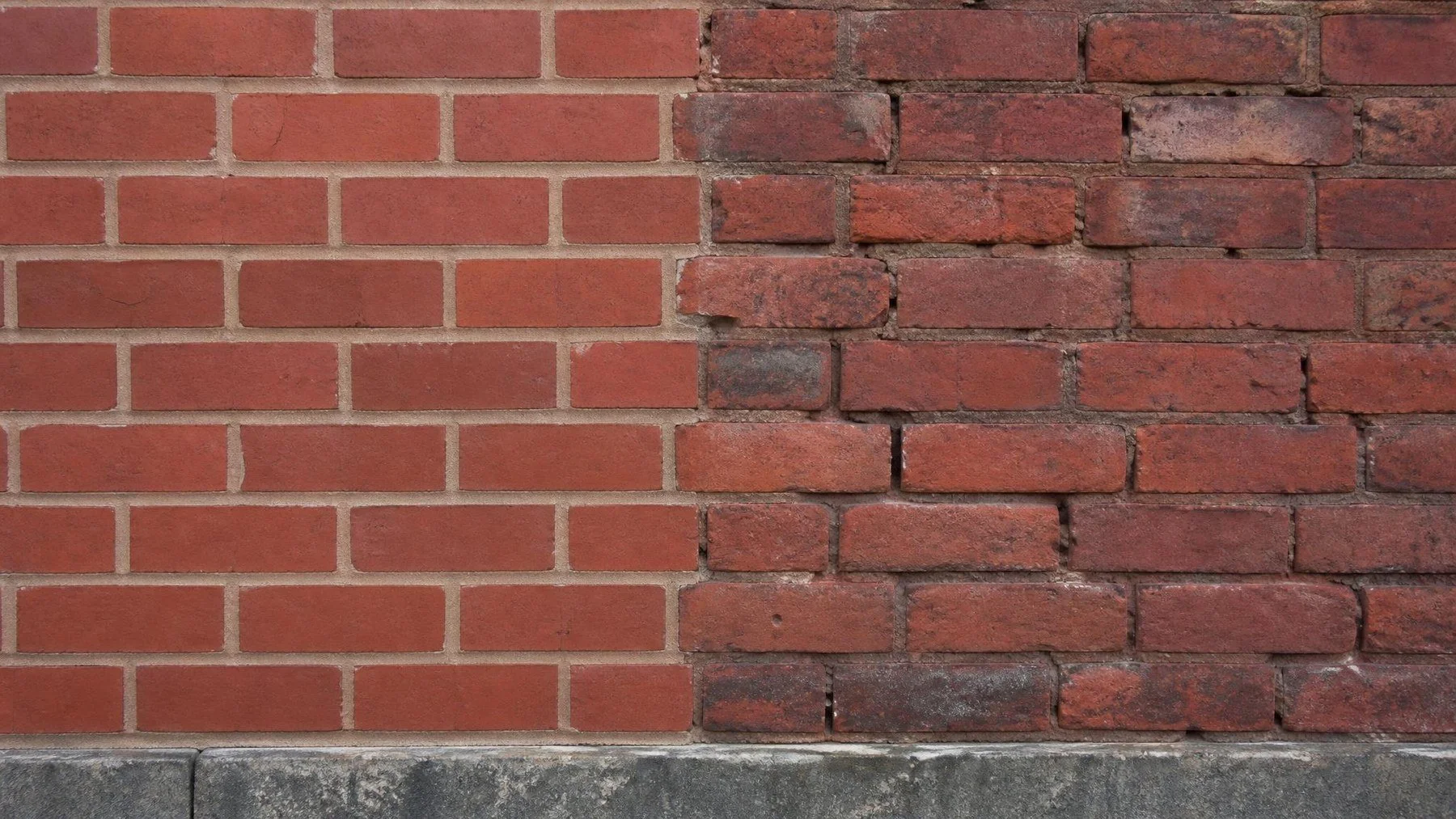
Two contractors quote the same century home and one calls it repointing while the other calls it tuckpointing. Here is the repointing vs tuckpointing answer in one line. Repointing replaces deteriorated mortar to restore joint performance, while traditional tuckpointing is a decorative joint treatment, although the terms are often used interchangeably in local service searches.
That last clause is the part that confuses people, and it is not the contractors being careless. In Toronto and across North America the phrase tuck pointing has drifted into everyday use as a name for joint repair in general, and most firms list it that way because that is what homeowners type.
We use whichever word the customer used and then describe the actual work, because the word on the quote matters far less than the three details further down this page. Here is what each term properly means.
What Repointing Actually Means
Repointing is the removal of failed mortar from the outer part of a joint and the replacement of it with new mortar. It is maintenance for the wall's joints, not makeup for the brick.
Why the joint is the part that wears
Mortar is deliberately the weaker element. It is the sacrificial layer that takes the movement, the salt and the freezing water so the units do not, and in time it gives out and needs renewing. That is the system working as intended rather than a sign of poor construction.
What the work restores
A properly repointed joint keeps water out of the wall core, carries the small movements the wall makes, and leaves the brick faces as the hardest surface. The appearance improves as a by product, but appearance is not the purpose.
What Tuckpointing Traditionally Means
Traditional tuckpointing is a decorative technique rather than a repair. The joint is filled with a mortar coloured to match the brick, and then a narrow ribbon of contrasting fine mortar, usually white, is applied into or onto that bed.
The effect is a wall that appears to have very fine, perfectly regular joints when the brickwork underneath is nothing of the kind. It was a way to make ordinary or irregular brick read as high quality gauged work. It is a finish applied to a joint, not a way of making a joint sound.
Where you still see it
On older buildings with a deliberately refined facade, and in conservation work where that original appearance is being retained. That decision belongs in historical restoration territory.
Why the Two Words Got Mixed Up
Three reasons, and none of them is anyone trying to mislead you.
- Both involve working mortar into an existing joint, so from a ladder they look similar.
- North American usage has broadened tuck pointing to mean joint repair generally.
- Homeowners search both words, so service pages carry both to be findable.
- Many firms genuinely do both, and the distinction rarely comes up in a quote.
- The original decorative technique is now rare enough that few people have seen it named.
So when a Toronto contractor offers tuck pointing, they are almost certainly describing joint repair. Our own tuck pointing page uses the term the way local customers do.
Side by Side
| Repointing | Traditional tuckpointing | |
|---|---|---|
| Purpose | Restore how the joint performs | Change how the joint looks |
| What is removed | Failed mortar, cut back to sound material | Little or nothing, it is applied as a finish |
| What goes in | Mortar matched to the units | Coloured bed plus a fine contrasting ribbon |
| Keeps water out | Yes, that is the point of it | Not on its own |
| When you need it | Mortar receded, cracked or soft | Only to match or retain an existing finish |
| Local usage | The technically correct term for repair | Commonly used to mean the same repair |
The Three Things to Ask About Instead
Whichever word appears on the quote, these are what decide whether the work lasts.
- Cut depth. How far back is the failed mortar being removed, and to what standard. Surface filling over soft mortar fails quickly whatever it is called.
- The mix. Is the new mortar matched to the existing units and the existing mortar, and is it softer than the brick. On older soft brick this is the single most important answer.
- The profile. How is the finished joint tooled, and does that profile shed water or hold it. The profile should follow the existing work rather than a house default.
Add two practical ones: how the work is protected while it cures, and how much of the wall is included. A quote that answers those five is a good quote under either name. Isolated unit replacement alongside the joints falls under brick repair.
So Which Do You Need?
If your mortar is receded, cracked or crumbling, you need repointing, and almost everyone in this city will sell you that under either name. If you have a refined older facade with fine white ribbon lines in the joints and you want that look kept, you need genuine tuckpointing and you should say so explicitly, because it is a different skill. For everyone else the words are interchangeable and the five questions above are what actually matter.
Show Brick Aid Masonry the damage
We are a family owned masonry company serving Toronto and the GTA. We will tell you what your joints actually need, give you an honest free quote, and back our work with a 2 year workmanship warranty. Request a free quote and send us photos of what you found.